Quite a while ago, a rancher made a deal with a wonderful local vet to deliver feral donkeys to the vet’s clinic for castration (of the males) and rehoming. The area in which the donkeys live had been suffering from drought for a long time, and ranchers had taken to shooting the donkeys in order to preserve forage for their cattle. This particular rancher had had enough of that practice, and came up with a way of corraling the donkeys for delivery to the vet clinic.
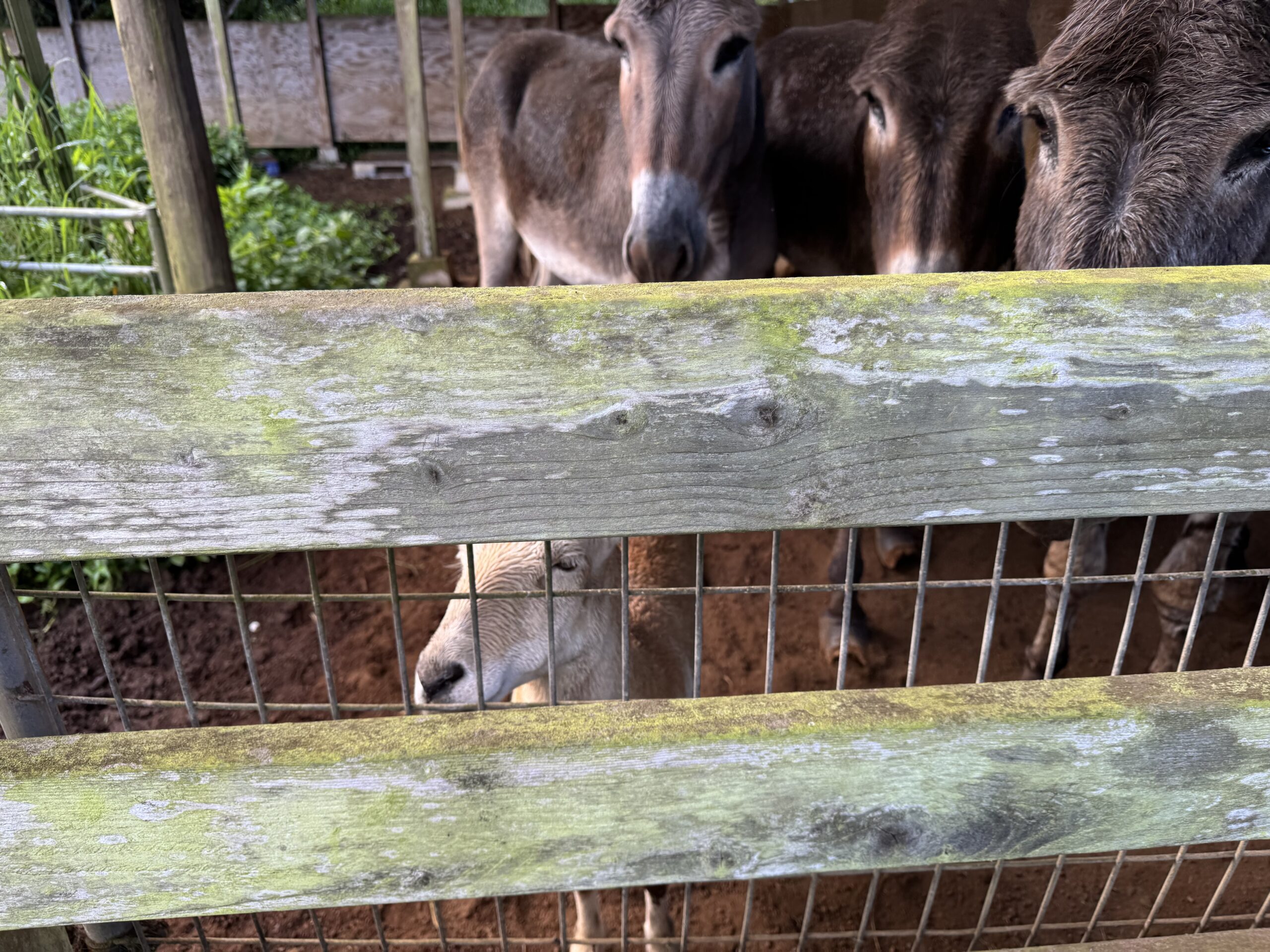
The poor vet had no idea he was to receive so many donkeys, and put out the word that he needed homes for them. We took four. Two turned out to be pregnant, and three very old donkeys eventually died, so now there are three. They are not tame, but they will tolerate having humans around if the humans provide food, water and minerals.
I have raised sheep for many years. Ideally, I’d rotate between horses, cattle, and sheep, for the sake of the health of my pastures, but right now there’s so much grass that I haven’t been able to find a rancher who wanted to run cattle on my land. It’s feast or famine in that regard.
The sheep lived a very long time, but eventually died off. I now have one old ewe left. I had been very worried about having only one sheep, but the donkeys have taken her in! This morning when I went down to the sheep shed to feed, the little old sheep was standing very calmly in a very tight space between a donkey and the rails of the shed. When I poured feed into a bin for the donkey, she slipped under his belly and began eating his food. He indicated that he would rather not share, and she moved over to her own bucket, completely unharmed. His own herd mates would not have dared stand so close or eat from that bin!
I’ve seen each of the donkeys step up to defend her when they perceived any threat to her, and I’ve seen her act as sentinel when they all decided to lie down for a rest. If I recall correctly, I had rationalized my decision to adopt donkeys by deciding that they would act as guardians for my sheep flock. I guess they did a good job, because I never lost a sheep to a dog attack. But I had no idea that the two species could develop such a close relationship!
I don’t get the sense that policy-makers at the state or county level have a clear idea of what they’re trying to accomplish. Are they trying to maximize tax revenue, increase food security, or maybe do both at once? (good luck!)
The county of Hawaii has various real property tax rates for different types of property. Agricultural rates are higher than homeowner rates. Assessed values also depend upon the uses made of land. Within the agricultural classification, there are different and higher assessed values for intensive uses such as crop growth, compared to pasture. Assessed values for ag land are always below fair market value.
The county, or at least some council members, take the position that agricultural land owners are being “subsidized” by other real property tax payers. That has never made any sense to me. I pay homeowner rates on my home, and my pasture is assessed and taxed as agricultural land. Someone with a house that was their primary residence, on a 10,000 square foot lot, would pay less than I do, but would be likely to make the same or higher demands on public resources as I do.
If they’re trying to promote food security, the county should be granting the ag rate to anyone who is growing a food crop or raising animals for slaughter, or even just preserving the option to do so in the future, whether at a commercial level or for person consumption. But that is not the case. Instead, they are granting ag rates to people who grow ornamentals, which can’t be eaten but which are an excellent way to transporting pests from one area of the Big Island to another, or even farther.
And there is more to agriculture than the production of crops or animals for human consumption. The Big Island is home to many ranches and horse trail rides. The horses get old. Is pasturing them, either while they’re working or after they’re retired, an agricultural use? It should be, but how does that fit in to the schemes being dreamed up?
At the state level, they seem equally confused about what they are trying to accomplish. They want to acknowledge that subsistence agriculture is a valid use of agricultural land, which is definitely a step in the right direction, but they seem to be stumbling around in the dark in terms of what they are trying to accomplish. Their as yet vague ideas are likely to require more paperwork from small land holders, more taxes to pay the salaries of civil servants who may not have any idea of what they are supposed to be looking for, and will almost certainly result in further consolidation of land holdings, as the small holders are unable to jump through the hoops set for them by misguided and ill informed politicians and bureaucrats. Frankly, rather than making sausage, as Tim Richards is quoted as saying, I’d prefer that the policy makers proceed with a clear understanding of the goals they wish to accomplish. All I see, again and again, is that the policy makers feel as though some land owners are “cheating” and should pay more.
Hawaii County is a place of great beauty and vast open spaces. But it is also a place where the goals of food self-sufficiency and diversified and sustainable economic growth are taken seriously. At the moment, the County is heavily dependent on tourism, which leaves us in a precarious position when visitor numbers drop for any reason. We also import an appalling percentage of our food, which leaves us vulnerable to vagaries of labor strikes and natural disasters.
Hawaii County and the State restrict use of agriculturally zoned lands
First and foremost, the property taxes on land in agriculture are much lower than those on land used for residential purposes. The actual rate is higher for some agricultural land than it is for some residential land, but the assessed values to which those rates are applied results in significantly lower taxes. Grazing land, in particular, is assessed at about $10,000/acre for non-dedicated land, and is currently taxed at $9.35/$1000. Homeowner rates are currently $6.15/$1000 of assessed value, but the land and improvements are assessed at market value. Also, those low homeowner rates apply only to primary residences, not to second homes or homes held for income or investment. Rates are available here: http://www.hawaiipropertytax.com/tax_rates.html
So what constitutes an agricultural use, and where is County land use policy headed?
Some of the uses listed in the chart don’t do much to increase food production. There is obvious value in keeping land in agricultural use, in the sense that it is much easier to later convert open land to food production than it is to restore land that has been used for residential, commercial or industrial purposes so that it can be safely used for such production. But given the growing emphasis the State is placing on a diversified economy and food self-sufficiency, it is reasonable to expect increasing restrictions on use of agriculturally productive land for purposes other than food production and commercial agriculture. The days during which a developer could easily purchase a pasture, get it rezoned and subdivided, and build and sell houses, are gone.
Current restrictions on use of agriculturally zoned land.
Even now, the number of dwellings, and the type of occupants of dwellings, are restricted on some agricultural lands. Some lands are governed by the State Land Use Commission, and lands classified as less productive are subject to County regulation. This is a huge topic, and while I could post links to every source that would need to be consulted in order to make a determination as to the governing body and restrictions on a given parcel, I instead advise anyone considering a purchase of agriculturally zoned land in Hawaii County to consult with the Hawaii County Planning Department. Have the TMK of the parcel you are considering, and a planner should be able to outline for you all of the permitted and prohibited uses for that land. See also https://livinginwaimea.com/2019/03/29/kohala-ranch-property-taxes/
Don’t plan on paying for your agricultural land purchase by selling agricultural goods!
If you want to make a profit on agriculture in Hawaii, your options are even more limited. Some crops do reasonably well in some years, but given the cost of land, it is very difficult to thrive as a farmer or rancher in Hawaii, year in and year out. Nonetheless, there are quite a few ranchers and farmers here. Why? Because even though it is very hard work, it is also endlessly interesting and occasionally very rewarding!
**Horse Keeping in Hawaii: What You Need to Know**
*Updated May 2026. Originally published 2019.*
Horse keeping in Hawaii is not always fun. On the day I took this photo I had already been searching for my horses for a while, sopping wet because the rain had started unexpectedly and I had gone out without rain gear. I had just about concluded that I’d missed them standing under trees near the barn, when I did one last visual sweep toward the top of the property. You can barely see them in the picture, but the white spot just above center is one of them. They weren’t exactly stuck, but they were reluctant to come down a steep slope. I had to go up, halter the lead mare, and negotiate with her for a while before we agreed on a path toward the barn.
That’s horse keeping in Hawaii on a bad day. On a good day, they come down on their own at feeding time, they’re sound, and you have time to ride!
Pasture vs Stall
Keeping horses at pasture is better for them physically and mentally, and usually works out well for me since they know when to make their way back toward the barn. I only keep horses in when I’m instructed to do so by a vet, and I’m never sure it’s the right thing to do. If I had enough stalls for all my horses, maybe it would be ok, but if some are in and others are out, there’s a lot of stress – which can, of course, lead to colic and can also affect their ability to maintain a healthy weight and condition.
If they’re out and shivering, I sometimes will put blankets on them. The problem there is that I think they’re even more prone to rain rot with blankets on. So then I need to get aggressive about treating for rain rot.
Feed and Supplies
Finding quality horse feed on the Big Island has gotten easier in recent years. Here’s where I shop:
Mauna Kea Feed — the newest addition to Waimea’s horse keeping resources, with a great selection of feed and products. Worth checking out. They bring in some KER supplements.
Animal Health— also in Waimea, and always reliable and the only place I know of on the island that carries Hawaii Horse Minerals, which I consider essential. Our grasses contain a component that binds with calcium, making it unavailable for horses to metabolize. Hawaii Horse Minerals corrects this, keeping the calcium/phosphorus ratio healthy. I supplement all my horses with this free choice. (I do have some horses that require more, and then I turn to Kentucky Equine Research products.)
Paauilo Feed Store — a great backup, especially for hay and cubes.
Veterinary Care
We have some talented equine vets on the Big Island. I won’t name specific practitioners because the reality of island life is that it’s always unpredictable who will stay and who will eventually leave — and that information goes out of date quickly. Ask locally for current recommendations.
Make sure you develop and maintain a relationship with a vet you know and trust before you need one urgently. And then follow their recommended protocols. Don’t assume practices you followed elsewhere, or even here in the past, are going to be sufficient here and now. A friend recently learned this lesson the hard way – his well-bred colt became seriously ill from a type of roundworm not treatable, at least at the colt’s age, by any commercially available wormer. Without prompt veterinary intervention the horse probably would not have survived, and certainly would never have developed into the horse he’s hoping for.
My vet tailors his worming recommendations to the horse’s location and health history. It’s money well spent to get this right!
Where to Keep Horses on the Big Island
Without question, Waikii Ranch is the premier location for horses on the Big Island. The climate is about perfect — cool and dry. There are extensive riding trails, an arena, and a polo field. Getting through the design review process can be challenging and building costs are significant, so if you can find an existing property that suits your needs, that may be the smarter option.
If you’re looking for equestrian properties in the Waimea area, I’d love to help — it’s a specialty of mine and I understand what horse people need in ways that some realtors don’t. Feel free to get in touch.
Judy S. Howard, Esq. is a Realtor Broker with COMPASS in Waimea, Hawaii, and a licensed Hawaii attorney. She has kept horses on her 50-acre off-grid property near Waimea for nearly 30 years. She can be reached at judy@livinginwaimea.com or 808-885-5588.