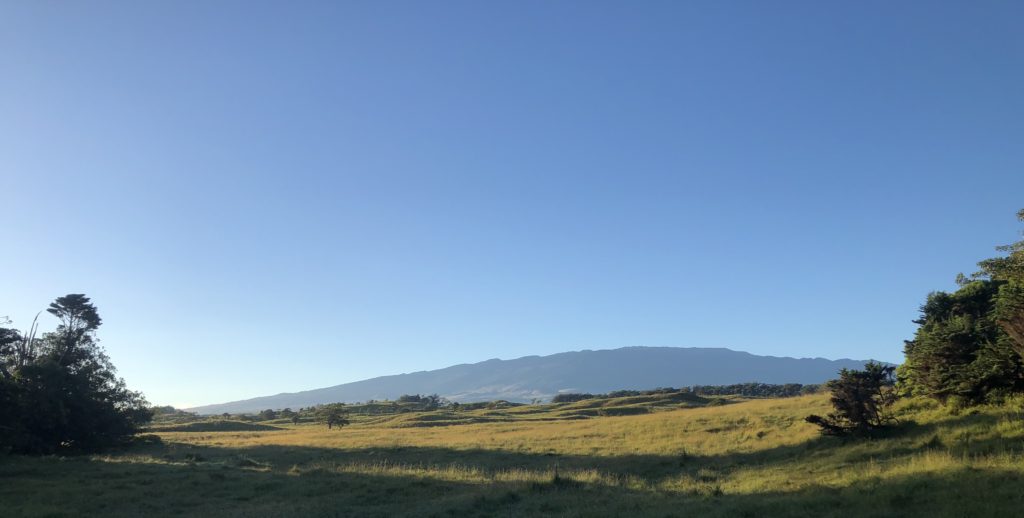
It’s a fair question — and an important one. Moving to Hawaii is expensive, logistically complex, and life-changing. Not everyone is happy here, and you owe it to yourself to do everything possible to make sure it’s the right move before you commit.
Visit Multiple Times and Stay as Long as You Can
Come more than once. Stay in different areas. The Big Island alone has dramatic differences between regions — Waimea’s cool ranch country feels nothing like Kona’s sunny leeward coast, which feels nothing like Hilo’s lush rainy east side. What suits one person perfectly drives another person away.
Finding places to stay has become more challenging since Hawaii County tightened vacation rental regulations in residential neighborhoods, but bed and breakfasts are still available and longer term rentals can sometimes be arranged. The investment of time and money to truly experience an area before buying there is always worth it.
The People May Surprise You
I hear this again and again from people who move here: it’s not just the place they fall in love with — it’s the people. Come with an open heart and treat the people you meet with genuine kindness and respect, and most will repay you with the aloha these islands are known for.
Do Your Research
Your realtor is a valuable source of information about what life here is really like day to day — not just the real estate transaction. The State of Hawaii also maintains a helpful newcomers guide.
Judy S. Howard, Esq. is a Realtor Broker with COMPASS in Waimea, Hawaii, and a licensed Hawaii attorney with over 30 years of experience. She can be reached at judy@livinginwaimea.com or 808-885-5588.
Hawaii County is a place of great beauty and vast open spaces. But it is also a place where the goals of food self-sufficiency and diversified and sustainable economic growth are taken seriously. At the moment, the County is heavily dependent on tourism, which leaves us in a precarious position when visitor numbers drop for any reason. We also import an appalling percentage of our food, which leaves us vulnerable to vagaries of labor strikes and natural disasters.
Hawaii County and the State restrict use of agriculturally zoned lands
First and foremost, the property taxes on land in agriculture are much lower than those on land used for residential purposes. The actual rate is higher for some agricultural land than it is for some residential land, but the assessed values to which those rates are applied results in significantly lower taxes. Grazing land, in particular, is assessed at about $10,000/acre for non-dedicated land, and is currently taxed at $9.35/$1000. Homeowner rates are currently $6.15/$1000 of assessed value, but the land and improvements are assessed at market value. Also, those low homeowner rates apply only to primary residences, not to second homes or homes held for income or investment. Rates are available here: http://www.hawaiipropertytax.com/tax_rates.html
So what constitutes an agricultural use, and where is County land use policy headed?
Some of the uses listed in the chart don’t do much to increase food production. There is obvious value in keeping land in agricultural use, in the sense that it is much easier to later convert open land to food production than it is to restore land that has been used for residential, commercial or industrial purposes so that it can be safely used for such production. But given the growing emphasis the State is placing on a diversified economy and food self-sufficiency, it is reasonable to expect increasing restrictions on use of agriculturally productive land for purposes other than food production and commercial agriculture. The days during which a developer could easily purchase a pasture, get it rezoned and subdivided, and build and sell houses, are gone.
Current restrictions on use of agriculturally zoned land.
Even now, the number of dwellings, and the type of occupants of dwellings, are restricted on some agricultural lands. Some lands are governed by the State Land Use Commission, and lands classified as less productive are subject to County regulation. This is a huge topic, and while I could post links to every source that would need to be consulted in order to make a determination as to the governing body and restrictions on a given parcel, I instead advise anyone considering a purchase of agriculturally zoned land in Hawaii County to consult with the Hawaii County Planning Department. Have the TMK of the parcel you are considering, and a planner should be able to outline for you all of the permitted and prohibited uses for that land. See also https://livinginwaimea.com/2019/03/29/kohala-ranch-property-taxes/
Don’t plan on paying for your agricultural land purchase by selling agricultural goods!
If you want to make a profit on agriculture in Hawaii, your options are even more limited. Some crops do reasonably well in some years, but given the cost of land, it is very difficult to thrive as a farmer or rancher in Hawaii, year in and year out. Nonetheless, there are quite a few ranchers and farmers here. Why? Because even though it is very hard work, it is also endlessly interesting and occasionally very rewarding!
**Horse Keeping in Hawaii: What You Need to Know**
*Updated May 2026. Originally published 2019.*
Horse keeping in Hawaii is not always fun. On the day I took this photo I had already been searching for my horses for a while, sopping wet because the rain had started unexpectedly and I had gone out without rain gear. I had just about concluded that I’d missed them standing under trees near the barn, when I did one last visual sweep toward the top of the property. You can barely see them in the picture, but the white spot just above center is one of them. They weren’t exactly stuck, but they were reluctant to come down a steep slope. I had to go up, halter the lead mare, and negotiate with her for a while before we agreed on a path toward the barn.
That’s horse keeping in Hawaii on a bad day. On a good day, they come down on their own at feeding time, they’re sound, and you have time to ride!
Pasture vs Stall
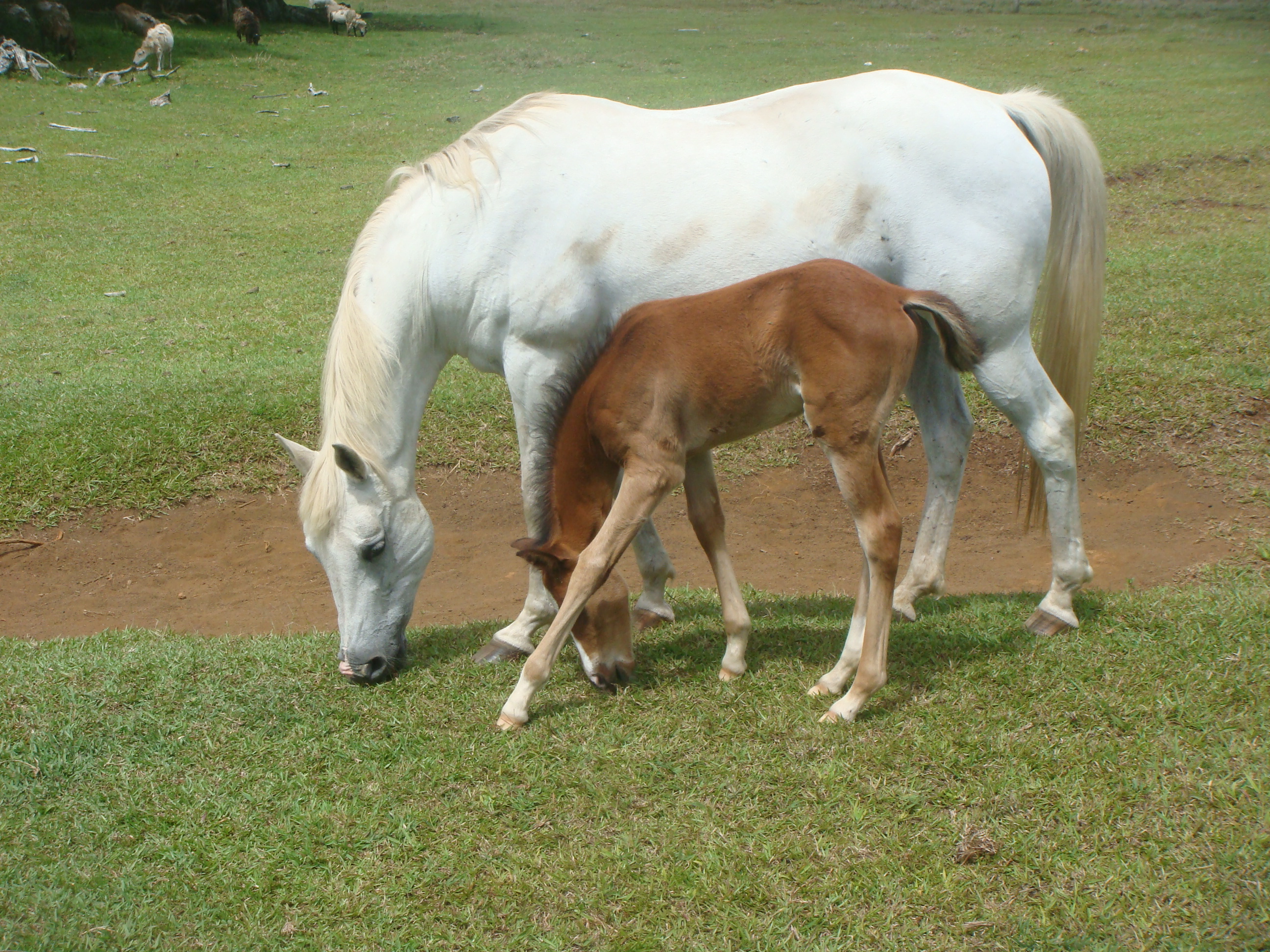
Keeping horses at pasture is better for them physically and mentally, and usually works out well for me since they know when to make their way back toward the barn. I only keep horses in when I’m instructed to do so by a vet, and I’m never sure it’s the right thing to do. If I had enough stalls for all my horses, maybe it would be ok, but if some are in and others are out, there’s a lot of stress – which can, of course, lead to colic and can also affect their ability to maintain a healthy weight and condition.
If they’re out and shivering, I sometimes will put blankets on them. The problem there is that I think they’re even more prone to rain rot with blankets on. So then I need to get aggressive about treating for rain rot.
Feed and Supplies
Finding quality horse feed on the Big Island has gotten easier in recent years. Here’s where I shop:
Mauna Kea Feed — the newest addition to Waimea’s horse keeping resources, with a great selection of feed and products. Worth checking out. They bring in some KER supplements.
Animal Health— also in Waimea, and always reliable and the only place I know of on the island that carries Hawaii Horse Minerals, which I consider essential. Our grasses contain a component that binds with calcium, making it unavailable for horses to metabolize. Hawaii Horse Minerals corrects this, keeping the calcium/phosphorus ratio healthy. I supplement all my horses with this free choice. (I do have some horses that require more, and then I turn to Kentucky Equine Research products.)
Paauilo Feed Store — a great backup, especially for hay and cubes.
Veterinary Care
We have some talented equine vets on the Big Island. I won’t name specific practitioners because the reality of island life is that it’s always unpredictable who will stay and who will eventually leave — and that information goes out of date quickly. Ask locally for current recommendations.
Make sure you develop and maintain a relationship with a vet you know and trust before you need one urgently. And then follow their recommended protocols. Don’t assume practices you followed elsewhere, or even here in the past, are going to be sufficient here and now. A friend recently learned this lesson the hard way – his well-bred colt became seriously ill from a type of roundworm not treatable, at least at the colt’s age, by any commercially available wormer. Without prompt veterinary intervention the horse probably would not have survived, and certainly would never have developed into the horse he’s hoping for.
My vet tailors his worming recommendations to the horse’s location and health history. It’s money well spent to get this right!
Where to Keep Horses on the Big Island
Without question, Waikii Ranch is the premier location for horses on the Big Island. The climate is about perfect — cool and dry. There are extensive riding trails, an arena, and a polo field. Getting through the design review process can be challenging and building costs are significant, so if you can find an existing property that suits your needs, that may be the smarter option.
If you’re looking for equestrian properties in the Waimea area, I’d love to help — it’s a specialty of mine and I understand what horse people need in ways that some realtors don’t. Feel free to get in touch.
Judy S. Howard, Esq. is a Realtor Broker with COMPASS in Waimea, Hawaii, and a licensed Hawaii attorney. She has kept horses on her 50-acre off-grid property near Waimea for nearly 30 years. She can be reached at judy@livinginwaimea.com or 808-885-5588.
Recycling in Waimea takes some effort. The county does not make it easy. Mixed recycling is available at most transfer stations, including the one in Waimea. Glass and metal can be separately recycled. The best information on what is acceptable is here: http://www.hawaiizerowaste.org/recycle/
The County has recently stopped accepting plastics. This is a nation-wide issue, but that doesn’t make it any easier to bear. I hope a local entrepreneur will soon start a business manufacturing items using locally recycled plastics, but that will take a few years.
Recycle Across America is doing some great work in both encouraging recycling and educating the public about how to recycle effectively. https://www.recycleacrossamerica.org/. I gather that plastic recycling has come to a stand still because China decided it was too costly to clean soiled plastics. If only we had all rinsed our plastic containers!
Recycling hazardous household waste here is even more inconvenient. There is only one day a year when the Waimea transfer station accepts hazardous household waste. Obviously, many people are going to take the expedient step, and simply discard such waste into the trash bins. The good news is that if you store your hazardous wastes up and schedule your time to deliver it to the transfer station on the right day, the people staffing the project are fantastic! Very friendly and efficient.
Recycling in Waimea is not easy, but it is worth the effort!